SEO vs Google Ads Small Businesses

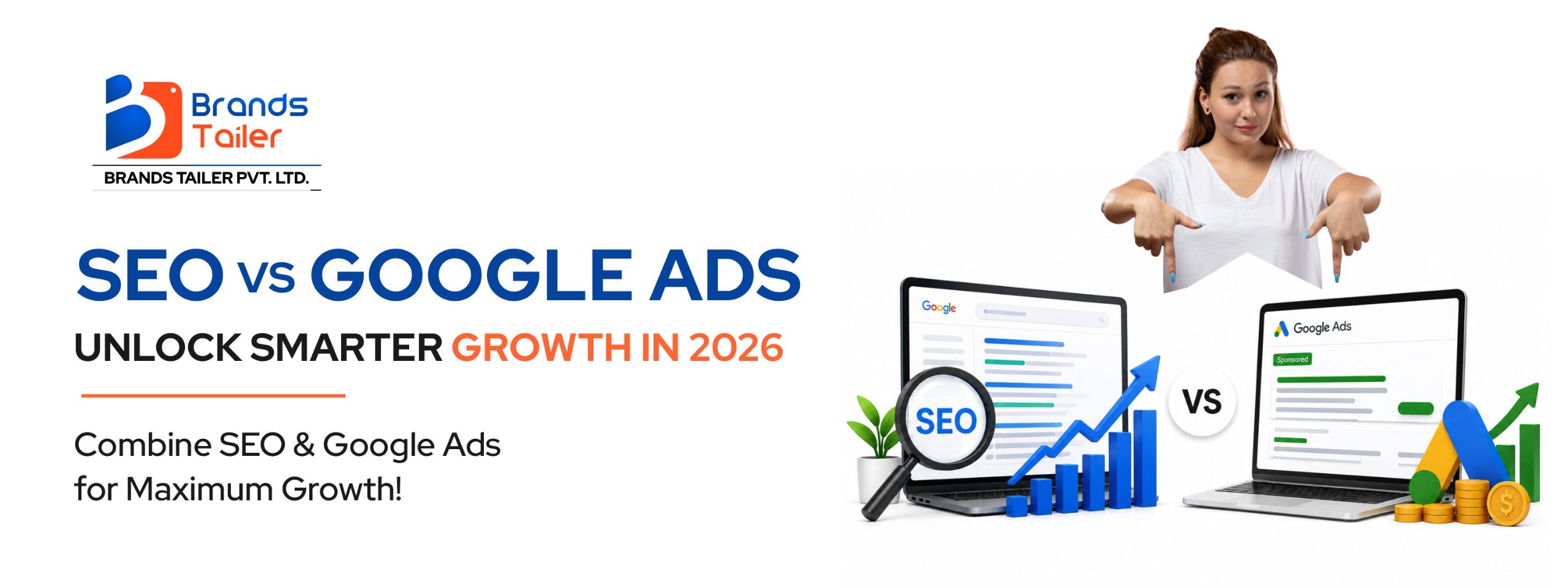
For most small businesses, SEO is better for long-term organic visibility and sustainable traffic, while Google Ads is better when you need immediate visibility, leads, or sales. In many cases, the strongest strategy is to use Google Ads for short-term results while building SEO for long-term growth.
SEO vs Google Ads: Quick Comparison
| Factor | SEO | Google Ads |
|---|---|---|
| Traffic | Organic | Paid |
| Speed | Slower to build | Fast |
| Initial results | Usually take time | Can start quickly |
| Long-term value | High | Depends on continued ad spend |
| Immediate leads | Usually slower | Often faster |
| Cost model | Ongoing SEO investment | Pay per click / ad spend |
| Best for | Long-term growth | Immediate visibility |
| Best approach | Sustainable organic visibility | Short-term acquisition |
Before hiring a digital marketing service, every single entrepreneur who enters Brandstailer asks the exact same question: SEO or Google Ads, which one should we choose? There is no one size fits all answer to this dilemma. On the one hand, there are people who stick to SEO, as it pays off much longer after you stop sending money. On the other hand, there are people who advocate Google Ads. Both camps have a point, depending on what stage the business is at.
This isn't a contest where one channel wins and the other loses. SEO vs Google Ads comes down to matching the tool to the problem you actually have right now. An individual who wants to set up his or her own clinic in a new area of town requires something different from what is needed by an ecommerce company that is about to launch a festive sale campaign. An actual estate developer who is opening a shop next to a new metro corridor has another problem altogether.
So here's the breakdown. What SEO is and how it works. What Google Ads is and how it works. Where each one earns its keep and where each one falls short. And how business owners across industries, doctors, restaurants, schools, real estate developers, manufacturers, startups, can work out which channel, or which mix of the two, delivers real ROI for their situation.
Think about the last time you searched for something you actually wanted to buy. A restaurant for Friday dinner, maybe. A hospital for a family member. A flat listing in a locality you'd had your eye on. Somewhere in that search you clicked an ad marked "Sponsored" near the top, or an organic result further down the page. Both exist because both work, just not in the same way and not at the same cost.
Organic vs paid marketing isn't a topic for a marketing conference panel. It's a budget and timeline decision, made every day by business owners who often don't fully understand what they're choosing between. Understand the mechanics and you spend smarter, whether that's patience put into SEO for small business growth or a tightly managed Google Ads for small business campaign that gets your phone ringing before the week is out.
Neither channel is inherently better or worse. They're built for different jobs, and the businesses that treat them that way, rather than picking a side and defending it, tend to build the strongest, most durable customer acquisition strategy over time.
What is SEO?
SEO stands for Search Engine Optimization. It is the practice of enhancing a website to improve its ranking on Google's search engine results pages, organically, or without paying. For instance, someone searches for “Best dentist near me” or “affordable 2BHK flats in Lucknow.” SEO will determine whether your listing appears on the first page or on the fifth page that no one looks at.
There's no direct payment to Google involved. You earn your spot through relevant content, technical work most visitors never notice, and credibility built up slowly.
How SEO Works
It isn't one activity. It's several parts working together.
On-page SEO refers to the process of optimizing titles, headings, body copy, and links within a page to make it easier for search engines to understand what the page is about. The technical SEO involves aspects like the speed of your website, its mobile-friendliness, security, and the general structure, and all these determine whether Google can crawl your site. Content SEO involves creating pages and blogs which actually address the needs of the searcher based on their intent. Off-page SEO consists of backlinks and reputation signals coming from other trusted websites to your own website. Local SEO, which includes your Google Business Profile, citations, and reviews, is very important if you depend on local clients and customers, is very important if you depend on local clients and customers.
None of this occurs overnight. There is a process that Google goes through before it decides whether to trust a website and give it high ranking over other websites.
It can be compared to making a good reputation in a new town. On the first day, nobody knows who you are. Reputation is built up by people testifying to your good work, and your ability to deliver on your word of promise. The same concept applies to search engines, only in an algorithmic way. Every good page, every link back, and every article that helps a search becomes a trust vote.
That's also why good search engine marketing outlasts whatever trend is popular this month. Algorithms shift constantly. The underlying principle, reward content that's genuinely useful, hasn't changed much in years.
Benefits of SEO
SEO for small business owners isn't a one-time setup. It compounds in ways paid ads simply can't.
Once a page earns organic visibility, it can continue attracting relevant traffic without a direct cost for every click. SEO can support long-term visibility, content discovery, and sustainable traffic when rankings are maintained over time. However, rankings still require ongoing optimization as competitors, search behavior, and search algorithms change.
Limitations of SEO
It's not all upside.
SEO results often take several months, although the timeline varies significantly depending on competition, website authority, technical condition, content quality, search intent, and consistency. There is no guaranteed ranking position because search algorithms and competitive conditions change over time. One blog post is rarely enough on its own; sustainable SEO usually requires an ongoing strategy covering content, technical optimization, internal linking, authority, and user experience.
None of that means skip SEO. It means go in with realistic expectations. Plenty of businesses quit after two or three months of modest results, right around the point where things typically start picking up. Patience paired with consistent execution is what separates businesses that see real organic growth from the ones who give up too early.
What is Google Ads?
Google Ads is a pay-per-click, or PPC, advertising platform where businesses bid to show ads at the top of search results, on YouTube, across partner sites, and on the display network. You pay every time someone clicks, for most campaign types, and where your ad lands depends on your bid combined with how relevant Google judges the ad to be.
How Google Ads Works
It runs on an auction. Someone searches for a keyword that you've bid on into their search engine, and there is an immediate auction on that search result, based on your bid, your quality score (based on how relevant your advertisement and your landing page is), and an estimate of how likely someone is to click on your ad.
There are many types of campaigns you can run depending on your objectives: Search, Display, Shopping, YouTube and Performance Max.
The biggest difference between pay per click advertising and traditional advertising is that in pay per click you have full control over your investment – you pay not because of exposure, but because of engagement – if someone types in a relevant keyword into a search engine and decides to click on your ad.
Benefits
For small business owners, Google Ads is often the fastest way to reach people already looking for what you sell.
Eligible Google Ads campaigns can begin generating visibility soon after approval and activation, although actual performance depends on targeting, budget, competition, bidding, ad relevance, and landing-page experience.
Targeting reaches down to location, device, time of day, demographics, and in some categories even household income. Budgets scale almost instantly, useful during launches or seasonal pushes. Every rupee spent is trackable to the click and conversion. And for urgent goals, product launches, event promotions, filling admission seats before a deadline, speed matters more than patience, which is exactly where Ads wins.
Limitations
There are real trade-offs too, ones business owners tend to underestimate until the first monthly bill arrives.
Google Ads costs stop when advertising stops, so paid traffic depends on continued campaign investment. Competitive keywords can have high cost-per-clicks, particularly in industries such as real estate, legal services, healthcare, finance, and other competitive sectors. Campaigns also require ongoing management because keyword targeting, bids, ad copy, budgets, conversion tracking, and landing pages all influence performance.
Businesses that get real value out of Google Ads treat it as an ongoing experiment, not something set up once and forgotten. Keywords need regular pruning. Ad copy needs testing and re-testing. Landing pages need to match what someone actually searched for, or budget leaks away without much to show for it.
SEO vs Google Ads Comparison
Most business owners just want a straight answer. Here's the side-by-side.
Cost Comparison
SEO needs investment in content, technical work, and link building, usually a monthly retainer, but it doesn't scale directly with clicks. Google Ads costs are tied straight to volume, more clicks means more spend. Tight budget and a long timeline, SEO wins on cost efficiency. Need fast results with flexible spend, Google Ads makes more sense despite the higher per-click cost.
Timeline Comparison
If a business needs qualified search traffic within days rather than months, Google Ads is generally the faster option. SEO is a marathon, meaningful movement takes months, and top rankings in competitive categories can take even longer.
Timeline shouldn't be the only factor though. A business chasing quick wins through paid search alone, never building any organic foundation, stays dependent on ad spend indefinitely. Nothing wrong with that if margins support it. But most small businesses eventually want their cost per customer to drop, and that's where SEO earns its keep, usually somewhere between month six and month twelve depending on competition and consistency.
ROI Matrix
Which One Should You Choose?
The answer to the SEO vs Google Ads question shifts by industry. Here's a breakdown.
Startup
Startups usually need visibility fast, especially pre-funding or during the early customer scramble. Google Ads delivers quick traction. SEO should still start on day one though, since it takes months to mature, and delaying it just pushes those gains further out. Many founders pause SEO the moment ads start bringing in leads, then realize a year later they're still paying full price for every customer. Even a lean SEO calendar running alongside ads, two or three pieces a month, keeps that longer-term asset building in the background.
Local Business
For local businesses, Local SEO and an optimized Google Business Profile can be strong long-term acquisition channels because they help businesses appear when customers search for products or services in a specific area. Google Ads can complement local SEO when a business needs immediate visibility, promotions, or additional lead volume.
Hospital
Decision making in hospitals and clinics is not taken casually by patients, who conduct thorough research beforehand on the very first appointment. SEO creates the necessary authority and the necessary depth in content, which is required by the research stage, while Google Ads is suitable for urgent care keywords or the introduction of a new service offering. Answers to the real questions of patients using friendly language work better than spending money on ads.
Restaurant
Restaurants rely heavily on local SEO, presence on Google Maps, and review marketing. Google AdWords can provide a helping hand during launch week or new menu roll-out period, but regular traffic that helps keep the restaurant going generally comes through organic local search along with word-of-mouth supported by online reviews. An average restaurant with decent images, reviews, and up-to-date Business Profile tends to emerge a winner when people try to answer the question “Where shall we have dinner today?”
Real Estate
Real estate is a big, slow decision, buyers research for weeks, sometimes months, before committing. SEO content, project pages, locality guides, comparison articles, builds trust across that journey. Google Ads works well for high-intent searches like "flats for sale in Gomti Nagar," where the buyer is already close to deciding. Developers running both catch buyers at every stage: SEO content for the early research, targeted ads timed around site visits and possession updates for when buyers are ready to act.
E-commerce
E-commerce brands often operate both strategies concurrently. Google Shopping Ads create fast traffic that converts, whereas SEO-friendly product and category pages generate consistent sales that are free from any cost-per-click, helpful for products that have a continuous search demand. Campaigns that occur at specific seasons and newly released products require ad support initially but rank well later.
Schools and Manufacturing Companies
While two different worlds, it is interesting to note that there is a common thread that runs through both. Education institutions have to function within narrow windows for admissions, and this is why Google ads end up being used quite a bit during the enrollment period, while SEO content relating to curriculum, facilities, and outcomes plays an important role as parents start their research months before calling you. In manufacturing, it’s a different story due to long B2B sales cycles and less search activity overall.
Can SEO and Google Ads Work Together?
Yes, and For many businesses, combining SEO and Google Ads can provide a balanced acquisition strategy, with paid campaigns supporting immediate demand while organic search visibility develops over time. A hybrid setup uses Google Ads for immediate traffic and data while SEO builds toward long-term, sustainable visibility.
Here's roughly how it plays out. Ads hand you fast keyword performance data, exactly which search terms convert and which just burn budget. That data feeds directly into your SEO content strategy, so you're not guessing which topics deserve priority. Ads keep the pipeline full while organic rankings climb slowly in the background. Once SEO starts pulling meaningful traffic, you shift ad budget away from keywords you now rank for and put that spend toward new campaigns or gaps that still need attention.
This layered approach saves businesses from treating SEO vs Google Ads as an either-or decision. For many businesses, the combination works well because paid campaigns can provide immediate data and traffic while SEO builds longer-term organic visibility, weighted differently depending on where they stand.
There's a psychological angle too. When a potential customer sees your brand as both a paid ad and an organic result for the same search, it builds an impression of authority, even if they never consciously notice why. It signals an established player rather than a business that started last month. That dual visibility lifts click-through rates in a way neither channel manages alone.
For businesses on a tighter budget, a practical starting split often looks like 60 to 70 percent toward whichever channel matches the immediate goal, with the rest feeding the other channel enough to keep it moving. As SEO gains traction, that ratio shifts naturally, freeing up ad budget for new campaigns, competitor keywords, or new markets.
Common Mistakes Businesses Make
Getting the SEO vs Google Ads decision wrong is expensive, wasted ad spend or months lost on content that never ranks. Here are the mistakes we see most often.
Most of these come down to impatience or a lack of coordination between whoever manages ads and whoever manages content. Fixing that usually costs nothing more than a shared calendar and a monthly check-in between the two.
Which Strategy Works Better for Businesses in Lucknow?
Lucknow's market moves at its own pace. Real estate developers along corridors like Sultanpur Road, Shaheed Path, and Raebareli Road deal with buyers who research extensively before committing, comparison shopping between two or three projects for weeks. For these developers, SEO content covering locality guides, RERA compliance, and comparison articles builds the trust that long-consideration buyers need, while Google Ads catches ready-to-buy searches during active site visit campaigns closer to decision time.
Local businesses, clinics, restaurants, retail outlets across the city, benefit heavily from local SEO paired with a strong Google Business Profile, since most nearby customers search with location-specific intent, "near me" or a named area. Businesses trying to establish themselves quickly, or running a seasonal promotion, lean on Google Ads for the quick visibility boost while their organic presence builds up in the background.
For Lucknow businesses figuring out where to start, working with a Digital Marketing Agency in Lucknow that understands both channels, and how they apply to this local market, saves months of trial and error.
What makes this market interesting is the mix, highly localized, trust-driven buying behavior alongside a growing habit of digital research before anyone commits. A family evaluating schools. A patient choosing between hospitals. A buyer comparing real estate projects along Sultanpur Road. All of them search online first now, even when the decision itself still happens over a phone call or a site visit. That's exactly why local businesses combining strong SEO fundamentals with well-timed Google Ads outperform competitors relying on just one channel, in a market where reputation and word of mouth still carry real weight.
Conclusion
There's no clean winner in the SEO vs Google Ads debate, and anyone telling you otherwise is probably selling you something. The right call depends on your goals, your budget, your timeline, and how your customers actually search and buy. Startups and urgent campaigns usually need the immediate reach Google Ads gives you. Established local businesses, hospitals, and real estate developers dealing with longer buyer journeys tend to see stronger long-term ROI from SEO instead. More often than not, running both together, weighted to match wherever the business stands, beats picking just one.
The smartest move isn't chasing whatever channel happens to be trending this year. It's building around where your business stands right now, and where you want it to be in 12 months.
Need help deciding between SEO and Google Ads? Talk to Brandstailer for a free strategy consultation.
"Consistency is key to local rankings."
Frequently Asked Questions
Abhishek Yadav is an SEO Manager at Brandstailer with 4+ years of experience in Search Engine Optimization, Local SEO, Technical SEO, Google Business Profile optimization, and Digital Marketing. He helps businesses improve search visibility, generate qualified leads, and achieve sustainable online growth through data-driven SEO strategies.